
Types of Qatl and Their Punishments under Pakistan Penal Code (PPC)
In criminal law, unlawful homicide known as Qatl (قتل) in Pakistani jurisprudence is treated with the utmost gravity. Under the Pakistan Penal Code (PPC), 1860, the law governing Qatl was significantly overhauled following Islamic legal principles (Law of Qisas and Diyat / قانونِ قصاص و دیت).
According to Chapter XVI (Sections 299 to 338-H), Qatl is divided into four categories based on intention (Mens rea / نیت), act (Actus reus / عمل), and knowledge. This guide breaks down each types of Qatl, its relevant PPC sections, and legal punishments.
What is Qatl?
Under Section 299 of the PPC, Qatl refers to the causing of death of a human being by another human being through an act, omission, or illegal means. The law differentiates between intentional murder, accidental death, and negligence to ensure fair sentencing.
1.Qatl-i-Amd (قتلِ عمد Intentional Murder)
Legal Definition and Sections:
Defined under Section 300 of the PPC, Qatl-i-Amd (قتلِ عمد) occurs when a person, with the deliberate intention of causing death or causing bodily injury likely to cause death, commits an act that results in the victim’s death.In section 301 define single fire on vital part is Qatl-e-amd.
Key Elements:
.Deliberate intention (نیت) to kill or inflict serious injury.
.Use of a deadly weapon or dangerous means.
Punishments (Section 302 PPC / سزائیں):
Depending on the evidence and legal standards, Section 302 provides three forms of punishment:
(section 302a)Qisas (قصاص): Death penalty imposed as equal retribution if proof under Tazkiyah-al-Shuhood (تزکیۃ الشہود) is fulfilled. For giving Qisas punishment first there must be check competency of witnesses.
Tazkiyah-ul-shuhood: Tazkiyah-ul-Shuhood refers to the process of verifying the credibility, character, honesty and reliability of witnesses before their testimony is accepted as legally valid. یعنی گواہوں کی سچائی اور اعتبار کو جانچنے کا عمل۔
(Section 302b) Imprisonment up to 25 years: Applicable in specific scenarios where Qisas is waived or not applicable under Islamic provisions. Many people convicted in 302 is fall in 302b.
(Section 302c )Ta’zir (تعزیر): Death penalty or imprisonment for life (قیدِ با مشقت) imposed based on facts and circumstances if Qisas evidence is insufficient.
Section 303 Qatl committed under ‘ikrah-i-tam’ or ‘ikrah-i-naqis’:
(1) Qatl under Ikrah-i-Tam: (Extreme Duress / زبردستی قتل کروانا / no option)
.The killer gets 10 to 25 years in prison.
.The person who forced him (the coercer) is punished for Qatl means what type of Qatl committed.
Example:
A is forced at gunpoint to kill B. A gets 10–25 years and coercer is punished for murder.
(2) Qatl under Ikrah-i-Naqis: (Lesser Duress / کم دباؤ / has choice)
.The killer punished A/c to the type of qatl they committed.
.The coercer gets upto 10 years prison.
Example:
A is threatened but still has a choice and kills B. A is punished for murder, and the coercer gets upto 10 years.
2.Qatl Shibh-i-Amd (قتلِ شبہ عمد – Semi-Intentional Murder)
Legal Definition & Section:
Section 315 of PPC defines Qatl Shibh-i-Amd (قتلِ شبہ عمد):
1) Intention to Harm: The person intends to hurt someone’s body or mind.
2) Use of Weapon/Action: He use a weapon or do something that normally wouldn’t cause death.
3) Death Occur: The person being harmed dies, or someone else dies because of that act.
This situation is called Qatl-Shibh-i-amd.
Example:
If someone hits another person with a stick intending to injure him, but the victim unexpectedly dies, it would be considered as Qatl Shibh-i-amd.
Punishments (Section 316 PPC / سزائیں):
Diyat (دیت): Mandatory payment of blood money/compensation to the legal heirs (ورثاء) of the deceased.
Ta’zir (تعزیر): Imprisonment up to 25 years in addition to Diyat.
3.Qatl-i-Khata (قتلِ خطا – Homicide by Mistake or Accident)
Legal Definition and Section:
Defined under Section 318 of the PPC, Qatl-i-Khata (قتلِ خطا) refers to causing the death of a person without any intention to cause death or harm, either by mistake of act (فعل کی غلطی) or mistake of fact (واقعہ کی غلطی).
Example:
Aiming a gun at a target during hunting, but hitting a person standing nearby by mistake.
1- Mistake of Law (Sec 79 PPC):
The person performs an action that accidentally causes death.
(جب کوئی بندہ قانون کو غلط سمجھ کر crime کرے۔)
But law says; “Ignorance of law is no excuse”.
مثلاً: بلال کہتا ہے کہ مجھے پتہ نہیں تھا کہ شراب پینا Illegal ہے۔
This is mistake of law. There is no defence.
2- Mistake of Fact (Sec 76 & Sec 79 PPC):
The person misunderstands the situation and unintentionally causes death.
Mistake of Fact is a valid defence if there is good faith (حسنِ نیت).
PPC Section Reference:
Section 76 PPC: Act done by a person bound, or by mistake of fact believing himself bound, by law.
Section 79 PPC: Act done by a person justified, or by mistake of fact believing himself justified, by law.
Punishments (Section 319 & 320 PPC / سزائیں):
Section 319 (General Khata): Payment of Diyat (دیت) to legal heirs, and optional imprisonment up to 5 years.
Section 320 (Khata by Rash/Negligent Driving): Payment of Diyat (دیت) plus imprisonment up to 10 years.
4.Qatl-bis-Sabab (قتل بالسبب – Indirect Homicide)
Legal Definition and Section:
Defined under Section 321 of the PPC, Qatl-bis-Sabab (قتل بالسبب) occurs when a person does not intend to cause death or harm, but unlawfully does an act that indirectly becomes the cause of another person’s death.
Example:
Digging an illegal pit on a public road without warnings; a pedestrian falls into it at night and dies.
Punishments (Section 322 PPC / سزائیں):
Diyat (دیت): Mandatory payment of financial compensation to the victim’s legal heirs.
Imprisonment may be awarded depending on judicial discretion and gravity of negligence.
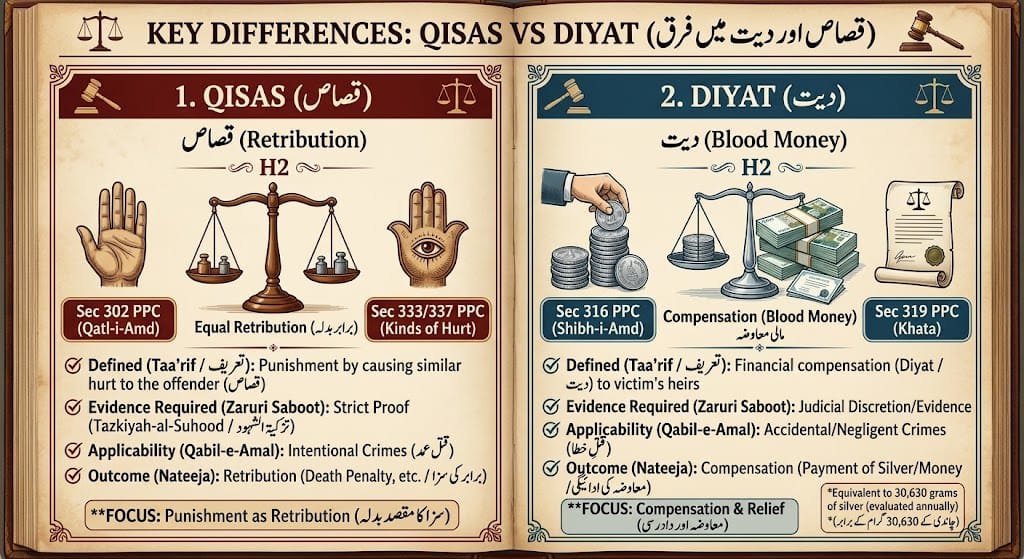
Difference Between Qisas and Diyat:
Qisas (قصاص – Retribution): Equal punishment for the offender (death penalty in murder cases), enforced by the state upon victim’s heirs’ demand. Life for life hurt for hurt.
Qisas Maxim; Principle of tooth for tooth and eye for eye.
Diyat (دیت – Blood Money): Financial compensation prescribed by the government (evaluated annually based on 30,630 grams of silver) paid to legal heirs (ورثاء).There is no maximum limit of diyat it depends upon the financial condition of victims and offender.
Frequently Asked Questions(FAQs)
What are 4 types of qatal in PPC?
The four types are Qatl-i-Amd (قتلِ عمد), Qatl Shibh-i-Amd (قتلِ شبہ عمد), Qatl-i-Khata (قتلِ خطا), and Qatl-bis-Sabab (قتل بالسبب).
What is the punishment for Qatl-i-Amd under Section 302?
Punishments include the death penalty as Qisas (قصاص), death penalty/life imprisonment as Ta’zir (تعزیر), or imprisonment up to 25 years depending on court findings.
Can Qatl-i-Amd be compromised (صلح / Compromise)?
Yes, under Pakistani law (Section 345 CrPC read with PPC provisions), offences of Qatl can be compromised through Wali (ولی) waiving Qisas or accepting Diyat, subject to court approval.
Case Laws:
1.2003 YLR 2666; Benefit of doubt
2. 2013PCr.LJ 499; Absence of accused
3.2010SCMR182; Age of accused
4.PLD1994SC679; Burden of proof
5.PLD1958LAH; Important case law to fix on murder preposition.
Conclusion
Understanding the four kinds of Qatl under the Pakistan Penal Code highlights how Pakistani criminal jurisprudence balances intent, negligence, and Islamic principles of justice. Each category ensures that legal consequences match both the act committed and the mental state behind it.