
1.Introduction to Article 10A
The Constitution of Pakistan guarantees several fundamental rights to protect individuals and ensure justice, equality and freedom. Among these rights, the right to a fair trial holds special importance because it ensures that no person is deprived of their legal rights without following a fair and lawful procedure.
Article 10A of the Constitution of the Islamic Republic of Pakistan, 1973, guarantees the right to a fair trial and due process of law. It protects individuals when their civil rights and obligations are being determined or when they face a criminal charge.
For example, if a person is accused of committing a crime, the court cannot simply declare that person guilty without examining the evidence and providing an opportunity to defend the case. Similarly, if a government authority intends to take an action that adversely affects someone’s legal rights, the person may be entitled to notice and a meaningful opportunity of hearing.
Therefore, Article 10A plays an important role in protecting human dignity, ensuring justice and strengthening the rule of law in Pakistan.
2.What Is the Right to Fair Trial?
The right to a fair trial means that every person has the right to have their case decided through a lawful, impartial and transparent judicial process.
It ensures that justice is not based on personal influence, pressure, discrimination or arbitrary decisions.
In criminal proceedings, an accused person must know the nature of the allegations, have a meaningful opportunity to defend themselves, and be allowed to challenge the evidence presented by the prosecution.
In civil proceedings, both parties should have a fair opportunity to present their claims, submit evidence and respond to the arguments of the opposing party.
Essential Elements of a Fair Trial
The following are some important elements of a fair trial:
- Independent and Impartial Court
The case must be decided by a court or legally competent forum that is independent and free from personal bias or external pressure. - Right to Be Heard
Every party must receive a reasonable opportunity to present their position before an adverse decision is made. - Right to Legal Representation
A person should have a meaningful opportunity to obtain legal assistance and representation in accordance with applicable law. - Knowledge of Allegations
In criminal cases, an accused person must be informed of the charge or allegations against them so that they can prepare their defence. - Opportunity to Present Evidence
Both parties should be allowed to produce relevant evidence in support of their respective positions, subject to the law of evidence and procedural rules. - Right to Cross-Examination
Where applicable under the law, a party must have an opportunity to challenge the credibility and reliability of opposing witnesses through cross-examination. - Reasoned Judgment
The court should provide reasons for its decision so that the parties can understand the legal and factual basis of the judgment. - Right to Appeal
Where an appeal is provided by law, the affected party should have access to the appropriate appellate forum.
These principles help ensure that justice is delivered through a fair process rather than through arbitrary decisions.
3.Constitutional Background of Article 10A
Article 10A was introduced into the Constitution of Pakistan through the Constitution (Eighteenth Amendment) Act, 2010.
Before the insertion of Article 10A, the principles of fair trial and due process were already recognized by Pakistani courts through constitutional interpretation, natural justice and other legal principles.
The Constitution already contained provisions such as Article 4, which guarantees the right of individuals to be dealt with in accordance with law, and Article 9, which protects life and liberty.
However, the Eighteenth Amendment gave the right to fair trial and due process an express and independent constitutional recognition by inserting Article 10A into Part II, Chapter 1, which deals with Fundamental Rights.
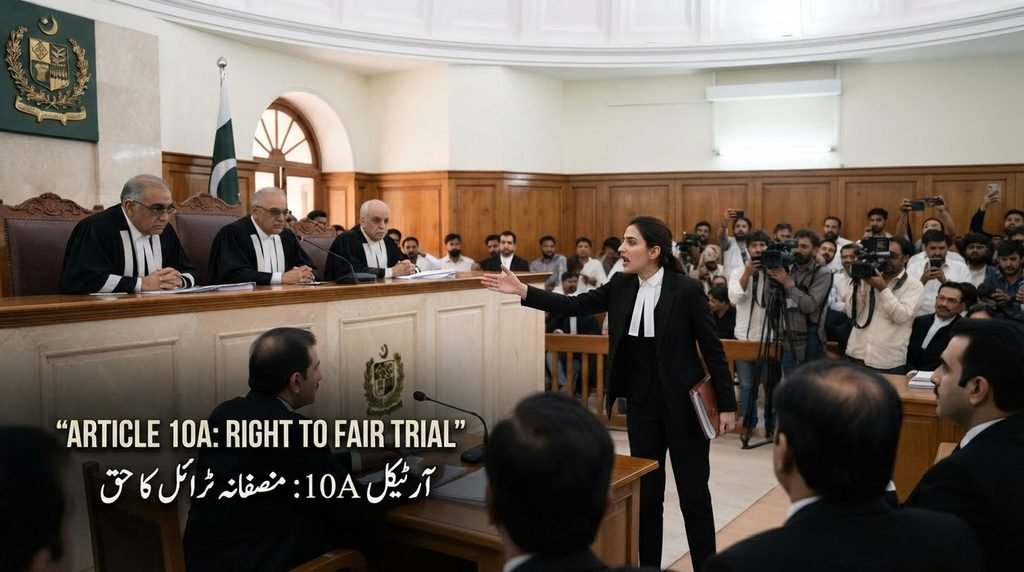
4.Exact Text of Article 10A of the Constitution of Pakistan
Article 10A is titled “Right to Fair Trial.”
The exact constitutional text reads:
“For the determination of his civil rights and obligations or in any criminal charge against him a person shall be entitled to a fair trial and due process.”
This provision establishes two important constitutional protections:
1.The right to a fair trial in the determination of civil rights and obligations.
2.The right to a fair trial in any criminal charge against a person.
The wording of Article 10A is important because it uses the expression “a person.” Therefore, the protection is not restricted only to Pakistani citizens. It extends to persons whose civil rights and obligations or criminal charges are being determined within the constitutional framework.
5.Meaning of Due Process of Law
Due process of law means that the State and its authorities must follow a lawful, reasonable and fair procedure before taking action that affects a person’s rights.
In simple words, it means that authorities cannot act arbitrarily or deprive someone of their legal rights without following the procedure established by law.
6.Who Is Protected Under Article 10A?
Article 10A protects a person whose civil rights and obligations or criminal charges are being determined.
Its protection is not limited to criminal accused persons.
It also extends to individuals involved in civil proceedings and certain administrative matters that have civil consequences.
Protection in Civil Cases
Article 10A also protects parties whose civil rights and obligations are being determined.
These may include disputes relating to property, contracts, financial obligations and other legally recognized civil rights.
For example, if two persons are involved in a property ownership dispute, both parties must receive a fair opportunity to present their documents, evidence and legal arguments before the court decides the matter.
Protection in Administrative Proceedings
The principles of fair trial and due process may also apply to administrative proceedings where an authority is determining matters that have civil consequences.
For example, if a public authority intends to impose a penalty or take an adverse decision affecting a person’s legal rights, the affected person may be entitled to a fair and meaningful hearing.
7.Right to Fair Trial in Civil Cases
Many people believe that the right to a fair trial is only available to persons accused of criminal offences. However, Article 10A expressly covers civil rights and obligations as well.
Civil cases generally involve disputes between individuals, organizations or other legal entities regarding their legal rights and responsibilities.
Examples include:
.Property ownership disputes.
.Contractual disputes.
.Recovery of money.
.Family-related civil disputes.
.Financial and commercial disputes.
.Matters involving civil consequences of administrative decisions.
In such proceedings, both parties must receive a fair opportunity to present their respective cases.
For example, suppose A files a suit claiming ownership of a property against B. The court must allow both parties to present their evidence, produce relevant documents and explain their legal positions.
The court should not decide the matter merely by accepting the statement of one party without considering the other party’s lawful opportunity to defend their position.
This is how Article 10A supports fairness in civil justice.
8.Right to Fair Trial in Criminal Cases
- The importance of Article 10A becomes particularly clear in criminal proceedings because an accused person may face imprisonment, punishment or even a death sentence.
- The Constitution requires that criminal proceedings must be conducted fairly and according to law.
- An accused person is entitled to important procedural protections, including:
- Being informed of the charge.
- Having a reasonable opportunity to prepare a defence.
- Access to legal representation in accordance with law.
- An opportunity to challenge prosecution evidence.
- An opportunity to cross-examine witnesses where legally applicable.
- An opportunity to produce defence evidence.
- A decision based on evidence and applicable law.
Practical Example
- Suppose the police arrest a person on suspicion of committing murder.
- The police cannot simply declare that person guilty.
- The prosecution must establish its case before the competent court through legally admissible evidence.
- The accused must be provided with the opportunity to defend themselves, it challenge the prosecution’s evidence and present their position.
- The court must independently examine the evidence and decide the matter according to law.
- Even if the allegation involves a serious offence, the accused does not lose the constitutional right to a fair trial.
- This principle protects the justice system from wrongful convictions and arbitrary punishment.
9.Important Supreme Court Judgments on Article 10A
The Supreme Court of Pakistan has explained the importance and scope of the right to fair trial and due process in several important judgments.
The following cases are particularly relevant for understanding Article 10A.
1. Naveed Asghar and Others v. The State (PLD 2021 SC 600)
Court: Supreme Court of Pakistan
This case is important for understanding the right to a fair trial in criminal proceedings, particularly where serious criminal charges and the death penalty are involved.
The Supreme Court emphasized the importance of proper evaluation of evidence and the duty of the appellate court to examine the evidence carefully in cases involving capital punishment.
The judgment reinforces the principle that even in serious criminal cases, an accused person cannot be deprived of the constitutional protection of a fair trial.
Legal Principle: The seriousness of an alleged offence does not remove the accused person’s right to a fair trial.
2. Chairman NAB v. Nasrullah (PLD 2022 SC 497)
Court: Supreme Court of Pakistan
This judgment recognized Article 10A as an independent fundamental right and emphasized its importance in the administration of justice.
The Court highlighted that fair trial and due process are essential requirements of the rule of law.
The principles of fairness must be respected whenever a person’s civil rights or criminal liability are being determined.
Legal Principle: The right to fair trial is an independent constitutional guarantee and must receive meaningful protection.
3. Justice Qazi Faez Isa and Others v. President of Pakistan and Others (PLD 2022 SC 119)
Court: Supreme Court of Pakistan
This is an important judgment concerning the right of hearing and due process.
The case involved proceedings relating to properties owned by the wife and children of Justice Qazi Faez Isa.
The Supreme Court discussed the importance of providing a meaningful opportunity of hearing before taking action that affects a person’s legal rights.
The Court explained that the expression “civil rights and obligations” under Article 10A has a wide scope and includes matters that produce civil consequences.
The judgment emphasized that a person should be given notice and an opportunity to explain their position before adverse action is taken against them, where required by law.
Legal Principle: A meaningful opportunity of hearing is an essential component of fair trial and due process.
10.Practical Examples of Article 10A
The following examples explain how Article 10A can apply in everyday situations.
Example 1 – Criminal Accusation Without a Fair Opportunity to Defend
Suppose a person is accused of committing robbery.
The court decides the case without providing the accused with a reasonable opportunity to defend themselves or challenge the evidence.
Such a procedure may raise serious questions concerning the right to fair trial under Article 10A.
Example 2 – Property Dispute
Suppose A claims ownership of a house, while B also claims ownership of the same property.
The court must provide both parties with a fair opportunity to submit ownership documents, evidence and arguments.
Deciding the case without properly hearing one party may violate the principles of fair trial and due process.
11.Frequently Asked Questions (FAQs)
Q1. What is Article 10A of the Constitution of Pakistan?
Article 10A guarantees every person the right to a fair trial and due process when their civil rights and obligations or a criminal charge against them are being determined.
Q2. When was Article 10A introduced in Pakistan?
Article 10A was introduced through the Constitution (Eighteenth Amendment) Act, 2010.
Q3. Is Article 10A a fundamental right?
Yes. Article 10A is included in Part II, Chapter 1 of the Constitution of Pakistan, which deals with Fundamental Rights.
Q4. Does Article 10A apply only to criminal cases?
No. It applies to the determination of civil rights and obligations as well as criminal charges.
Q5. Does Article 10A apply to government departments?
The principles of fair trial and due process may apply to administrative proceedings where civil rights or obligations are being determined. The precise procedural requirements depend on the nature of the matter and the applicable law.
Q6. What is the difference between fair trial and due process?
Fair trial focuses on ensuring that a case is decided through a fair and impartial process. Due process requires authorities to follow lawful and fair procedures before affecting a person’s rights.
Q7. Can a person challenge a decision made without a fair hearing?
Yes. Where a decision violates applicable law or constitutional requirements, the affected person may challenge it before the competent court or forum through the appropriate legal remedy.
Q8. Does an accused person have the right to cross-examine witnesses?
Yes, subject to applicable law and the nature of the proceedings, an accused person has the right to challenge prosecution witnesses through cross-examination.
Q9. Can a person be punished without being given an opportunity to defend themselves?
A person cannot lawfully be deprived of the protections required by the Constitution and applicable procedural law. Denial of a meaningful opportunity to defend may amount to a violation of fair trial and due process.
Q10. Which Supreme Court case is important for understanding Article 10A?
Some important judgments include Naveed Asghar v. The State (PLD 2021 SC 600), Chairman NAB v. Nasrullah (PLD 2022 SC 497), and Justice Qazi Faez Isa v. President of Pakistan (PLD 2022 SC 119).
12.Conclusion
Article 10A of the Constitution of Pakistan is one of the most important fundamental rights because it guarantees fairness, justice and due process in the determination of civil rights and criminal charges.
It ensures that no person should face an unfair legal process and that courts and relevant authorities must follow the requirements of law before making decisions that affect individual rights.
- The right to a fair trial is not limited to providing an opportunity to appear before a court. It also includes meaningful participation, an impartial decision-maker, a fair opportunity to present and challenge evidence, and a reasoned decision in accordance with law.Ultimately, justice is not only about reaching the correct decision; it is also about reaching that decision through a fair and lawful process.
- At Numan’s Law Guide, our aim is to make the Constitution of Pakistan easier to understand by explaining important constitutional provisions, legal principles and landmark judgments in simple language.