Kinds of Hurt under Pakistan Penal Code (PPC): Sections 332 to 337 Explained Simply
Understanding offences against the human body is essential for law students, practicing advocates, and competitive exam aspirants (such as CSS, PCS, or Judicial exams). In Pakistani criminal law, Hurt (نقصان / جسمانی چوٹ) covers any bodily pain, disease, infirmity, or injury caused to a person.
Following the Qisas and Diyat Ordinance, the provisions of Hurt in the Pakistan Penal Code (PPC) were revised to align with Islamic jurisprudence. This article breaks down the legal definitions, kinds of hurt, punishments, and important judicial precedents in straightforward language.
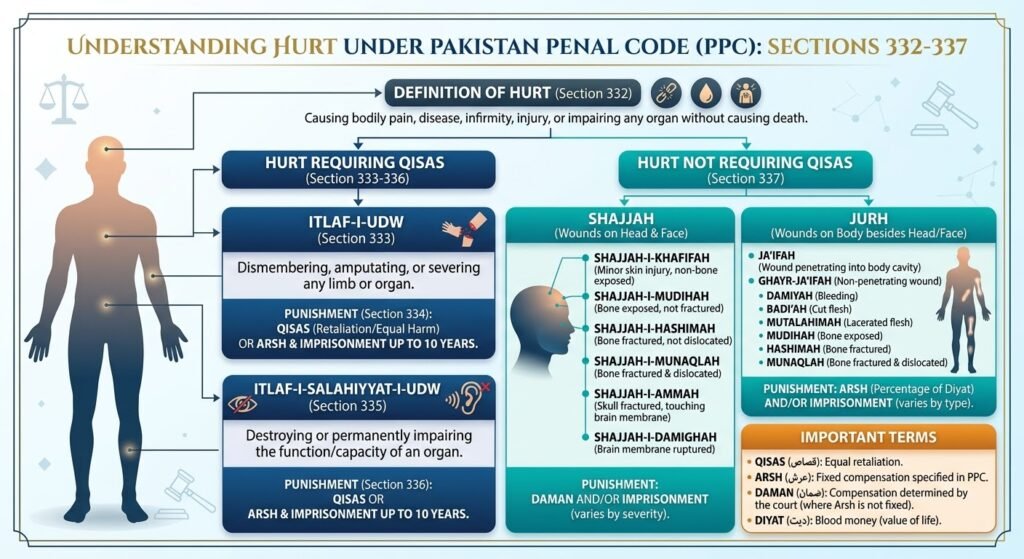
What is Hurt? (Section 332 PPC)
Under Section 332 PPC, a person is said to cause Hurt if they cause:
- Bodily pain (جسمانی درد)
- Disease (بیماری)
- Infirmity (کمزوری / جسمانی معذوری)
- Injury, damage, dismemberment, or disabling of any organ of the body or part thereof, without causing death.
- All the hurts are injuries but all the injuries are not hurt.
- Injuries: Any harm related to body, property, reputation, defamation e.t.c, is called injury.
Major Kinds of Hurt Under Section 332(2) PPC
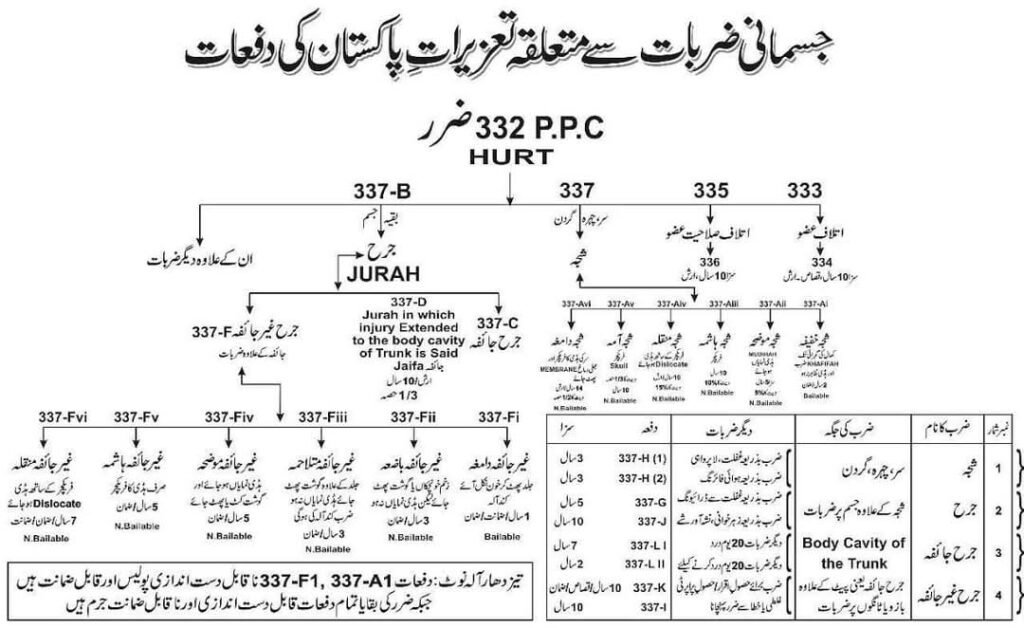
The PPC categorizes Hurt into six major categories. Each category carries distinct legal definitions, subtypes, and prescribed punishments (Qisas, Arsh, Daman, or imprisonment).
KINDS OF HURT (PPC)
- Itlaf-i-Udw (اتلافِ عضو) – Section 333 PPC
- Definition: Severing, dismembering, or cutting off any organ or part of the body.
- Simple Example: Cutting off someone’s finger, ear, or nose during a fight.
- Punishment (Section 334 PPC): Qisas (قصاص). If Qisas is not applicable or executable, the offender is punished with Arsh (عوض/مالی تاوان) and may also face imprisonment for up to 10 years.
- Itlaf-i-Salahiyyat-i-Udw (اتلافِ صلاحیتِ عضو) – Section 335 PPC
- Definition: Destroying or permanently impairing the function or capacity of an organ, without cutting it off.
- Simple Example: Blinding someone’s eye or causing permanent deafness by a blow to the ear.
- Punishment (Section 336 PPC): Qisas. If Qisas cannot be enforced, the offender pays Arsh and may receive up to 10 years imprisonment.
- Scope. The offence covers:
- Deprivation of complete sight
- Loss of sexual power
- Cutting of nose part or whole
- Loss of tooth other than milk tooth
- Cutting of any lip.
- Shajjah (شجہ) – Section 337 PPC ( injuries to head/face)
- Definition: Any hurt or injury caused specifically to the head (سر) or face (چہرہ) that does not amount to organ loss.
- Note: Shajjah is further divided into 6 distinct sub-types depending on the depth and severity of the injury (detailed in the section below).
- Jurh (جرح) – Section 337-B PPC
- Definition: A wound on any part of the body other than the head or face, which leaves a mark or penetrates into the body cavity.
- Two Main Branches:
- Jurh Jaifah (جرح جائفہ): A wound that penetrates into the body cavity (like a chest or stomach stab).
- Jurh Ghayr-Jaifah (جرح غیر جائفہ): A wound on the body that does not penetrate into the body cavity (like skin cuts or flesh wounds).
sub types of shajjah (شجہ)
- Shajjah-i-Khafifah (شجہ خفیفہ)
Section: 337-A(i) PPC
Nature & Meaning: Minor cut or scratch on head/face; simple injury without exposing bone.
Punishment: Daman (ضمان) and imprisonment up to 2 years. - Shajjah-i-Mudihah (شجہ موضجہ)
Section: 337-A(ii) PPC
Nature & Meaning: Wound exposes the bone of the head or face, but does not fracture it.
Punishment: Arsh (5% of Diyat) and imprisonment up to 5 years. - Shajjah-i-Hashimah (شجہ ہاشمہ)
Section: 337-A(iii) PPC
Nature & Meaning: Bone of the head or face is fractured without being dislocated.
Punishment: Arsh (10% of Diyat) and imprisonment up to 10 years. - Shajjah-i-Munaqilah (شجہ منقلہ)
Section: 337-A(iv) PPC
Nature & Meaning: Bone of head or face is fractured and dislocated from its original place.
Punishment: Arsh (15% of Diyat) and imprisonment up to 10 years. - Shajjah-i-Ammah (شجہ عامہ)
Section: 337-A(v) PPC
Nature & Meaning: Skull fractured and the wound touches the membrane of the brain (dura mater).
Punishment: Arsh (1/3rd of total Diyat) and imprisonment up to 10 years. - Shajjah-i-Damighah (شجہ دامغہ)
Section: 337-A(vi) PPC
Nature & Meaning: Most severe form; skull is fractured and the brain membrane is ruptured.
Punishment: Arsh (1/2 of total Diyat) and imprisonment up to 14 years.
Jurh (جرح) – Section 337-B PPC
Jurh refers to a wound on any part of the body other than the head or face, which leaves a mark or penetrates into the body cavity.
Jurh is divided into two primary sub-categories:
A. Jurh Jaifah (جرح جائفہ) – Section 337-C PPC
Definition: A wound that penetrates into the body cavity (chest, abdomen, stomach, etc.).
Example: A stab wound with a knife entering the abdominal cavity.
Punishment (Section 337-D PPC): Payment of Arsh (1/3rd of total Diyat) and imprisonment up to 10 years.
B.Jurh Ghayr-Jaifah (جرح غیر جائفہ) – Section 337-E PPC
Definition: A wound on the body (other than head/face) that does not penetrate into the body cavity.
Sub-types (Section 337-F PPC):
Damiyah (دامیہ): Skin torn, bleeding occurs. ( رگڑ آنا یا خون نکلنا۔ ان پہلی تین اقسام میں ہڈی نظر نہیں آتی )
Badi’ah (بدیعہ): Cut cutting into flesh. ( گوشت کٹ جانا لیکن ہڈی نظر نہ آنا۔ اس میں سوئی یا کوئی چھوٹا زخم ہوتا ہے (جس کا منہ چھوٹا لیکن گہرائی زیادہ ہوتی ہے
Mutalahimah (متلاحمہ): Flesh deeply lacerated. (خنجر یا بلیڈ وغیرہ سے بڑا اور گہرا زخم ہونا جس سے گوشت چیر جائے۔)
Mudihah (موضجہ): Bone exposed. (جسم کے نیچے والے حصے کی ہڈی نظر آ جانا۔)
Hashimah (ہاشمہ): Bone fractured. (ہڈی ٹوٹ جانا (جیسے ٹانگ یا بازو کی ہڈی) لیکن اپنی جگہ سے نہ ہلنا۔)
Munaqilah (منقلہ): Bone fractured and dislocated. (ہڈی کا ٹوٹنا اور اپنی جگہ سے منتقل یا ہل جانا۔)
Other Kinds of Hurt – Sections 337-G to 337-L PPC
Hurt by Rash or Negligent Act (Sec 337-G): Causing hurt by reckless driving or negligent handling of machinery.
- Hurt by Poison or Administering Intoxicants (Sec 337-J): Administering poison with intent to cause hurt or commit an offence (Punishment: up to 10 years imprisonment + Arsh/Daman).
- Extorting Confession (Sec 337-K): Inflicting hurt to extract a confession or force restoration of property.
Key Islamic Punishments Explained: Qisas, Arsh, and Daman
To master offences against the human body in Pakistani legal practice, understanding these financial and retributive terms is vital:
- Qisas (قصاص): Equal punishment for the harm caused (an eye for an eye, a tooth for a tooth).
- Arsh (عرش): Fixed compensation specified in the PPC for specific types of injuries, calculated as a percentage of Diyat (دیت).
- Daman (ضمان): Compensation determined by the court for injuries where no fixed Arsh is specified in law. It covers medical expenses and suffering.
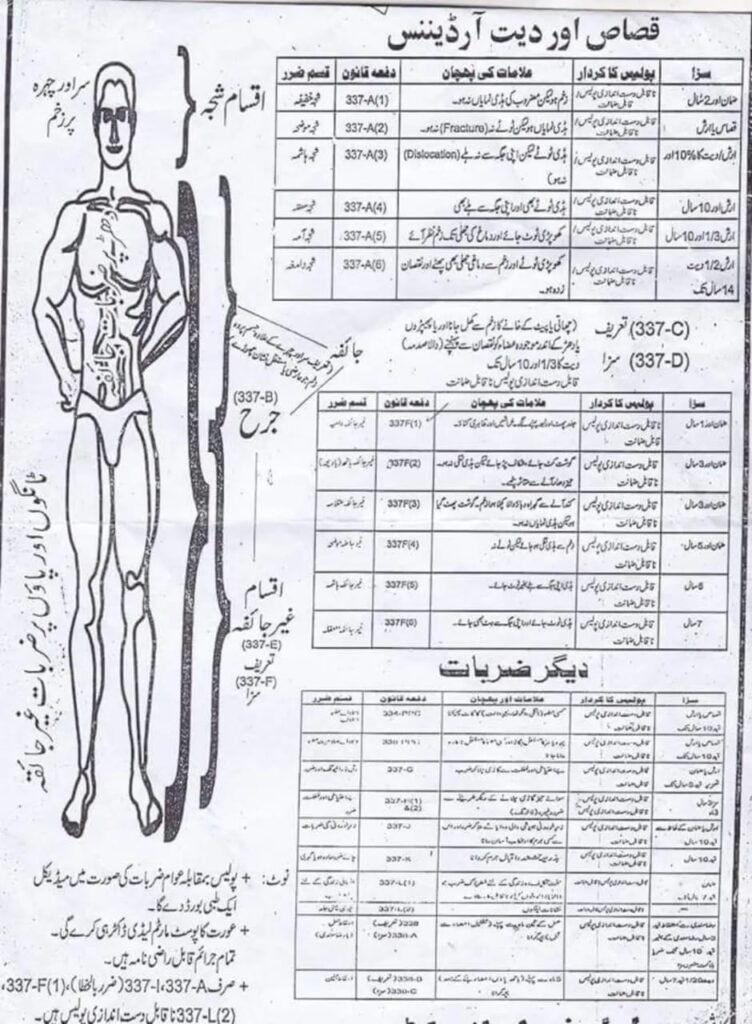
Relevant Pakistani Case Laws on Hurt
Muhammad Arshad v. The State (2018 YLR 1245 SC):
- Ratio Decidendi: Medical evidence must precisely match the statutory definition of Shajjah or Jurh. Medico-Legal Reports (MLR) failing to specify bone exposure cannot automatically lead to conviction under Shajjah-i-Mudihah.
State v. Abdul Waheed (PLD 2003 SC 411):
- Ratio Decidendi: The Supreme Court clarified the application of Daman vs Arsh, emphasizing that where specific percentage of Arsh is not provided, courts must carefully assess financial loss and injury severity to fix Daman.
Gul Zaman v. The State (2020 MLD 567 Lahore):
- Ratio Decidendi: Causing hurt under Section 337-F(iii) (Mutalahimah) requires proof of intention or knowledge (Mens Rea). Sudden unprovoked quarrels without premeditation may mitigate sentence length.
Frequently Asked Questions (FAQs)
Q1: What is the main difference between Shajjah and Jurh?
Shajjah applies exclusively to injuries on the head or face (سر یا چہرہ). Jurh applies to injuries on all other parts of the body.
Q2: Is Qisas always mandatory in cases of Hurt?
No. Qisas is not enforced if medical experts confirm that executing Qisas might cause death or excessive harm beyond the original injury, or if the victim forgives the offender (Sulh).
Q3: Who decides the value of Daman?
The trial court determines the amount of Daman based on medical expenses incurred, loss of earnings, and severity of physical pain suffered by the victim.
Summary Checklist for Students & Practitioners
Sections 332–337-L govern all forms of Hurt under PPC.
- Head/Face hurt = Shajjah (6 subtypes).
- Body wound penetrating cavity = Jurh Jaifah.
- Body wound non-penetrating = Jurh Ghayr-Jaifah (6 subtypes).
- Organ dismemberment = Itlaf-i-Udw; loss of function = Itlaf-i-Salahiyyat-i-Udw.
Conclusion
Understanding the provisions of Hurt (حسبِ دفعات 332 تا 337 تعزیراتِ پاکستان) is essential for anyone studying or practicing criminal law in Pakistan. The law systematically categorizes bodily injuries based on their nature, location, and severity—distinguishing clearly between head/face injuries (Shajjah) and general body wounds (Jurh).
By integrating Islamic legal remedies such as Qisas, Arsh, and Daman, the Pakistan Penal Code ensures a balanced framework focused on both justice for the victim and accurate penalization for the offender. For legal practitioners, ensuring that medical evidence aligns with exact statutory definitions remains the key to successfully arguing these cases in court.